Forklift Loading vs Tail-Lift Delivery
Forklift loading and tail-lift delivery are both used for moving pallets and heavier goods, but they work in different ways. Choosing the right loading method helps avoid delays, failed collections and unsafe handling.
Forklift loading is usually better for heavier pallets, warehouse collections and side-loaded freight. Tail-lift delivery is useful when there is no forklift available and goods need to be loaded or unloaded from ground level.
Dippo Lills supports UK pallet courier and transport jobs where forklift loading, tail-lift vehicles, Luton vans, curtain-side vehicles or 7.5T transport may be required.
What Is Forklift Loading?
Forklift loading means the goods are lifted onto or off the vehicle using a forklift truck.
This is common at:
- Warehouses
- Distribution centres
- Factories
- Yards
- Commercial units
- Supplier premises
- Goods-in areas
Forklift loading is usually faster and safer for heavy pallets or multiple pallet loads. It is also useful when pallets need to be loaded from the side of the vehicle.
What Is Tail-Lift Delivery?
Tail-lift delivery uses a lifting platform at the rear of the vehicle. The tail-lift raises or lowers goods between the vehicle bed and the ground.
Tail-lifts are useful when:
- No forklift is available
- Goods need ground-level loading
- A pallet needs unloading at a shop, office or site
- A loading dock is not available
- The goods are within tail-lift capacity
Tail-lifts are often used with a pump truck to move pallets across flat, hard ground.
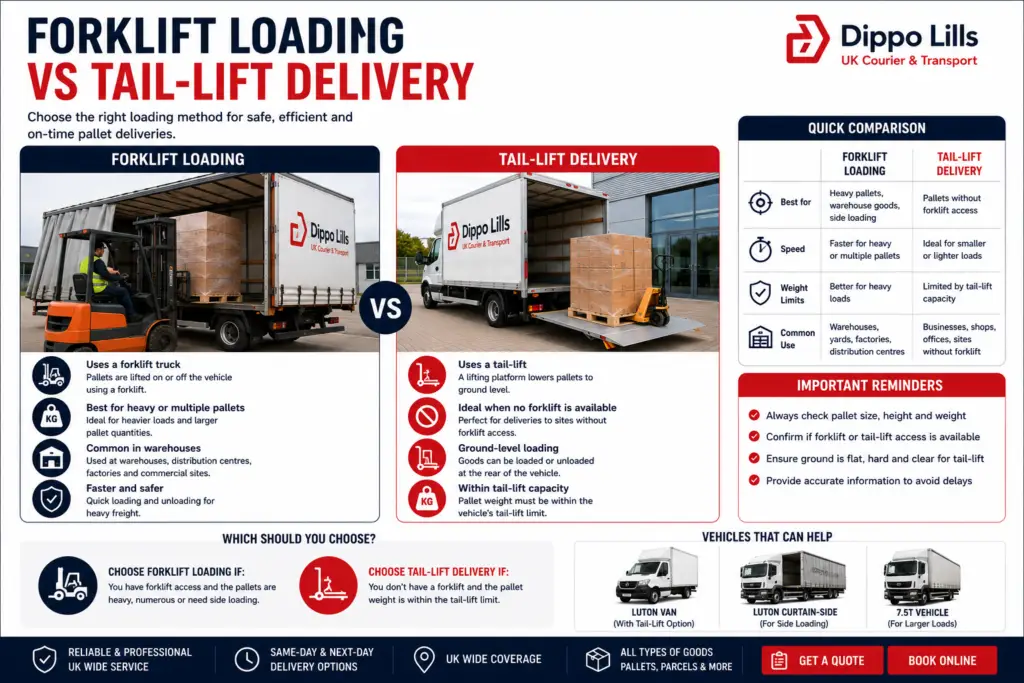
Quick Comparison
| Loading method | Best for | Main advantage |
|---|---|---|
| Forklift loading | Heavy pallets, warehouse goods, side loading | Faster and better for heavier freight |
| Tail-lift delivery | Pallets without forklift access | Useful for ground-level loading |
In simple terms, choose forklift loading when the site has forklift access and the goods are heavy or palletised. Choose tail-lift delivery when there is no forklift and the goods can be safely handled from ground level.
When Should You Use Forklift Loading?
Forklift loading is usually the better option when the goods are heavy, palletised or loaded from a warehouse.
Use forklift loading for:
- Heavy pallets
- Multiple pallets
- Commercial freight
- Warehouse collections
- Side-loaded pallets
- Stock movements
- Building supplies
- Event equipment
- Goods above tail-lift limits
If the pallet is too heavy for a tail-lift, forklift loading may be required.
When Should You Use Tail-Lift Delivery?
Tail-lift delivery is useful when the goods need to be loaded or unloaded without a forklift.
Use tail-lift delivery for:
- Pallets under the vehicle’s tail-lift limit
- Business stock
- Shop deliveries
- Office deliveries
- Sites without forklift access
- Ground-level unloading
- Smaller pallet deliveries
- Bulky goods that cannot be lifted by hand
A tail-lift is helpful, but it still has limits. The pallet must be stable, safe to move and within the lift capacity.
Weight Limits Matter
Weight is one of the most important details when choosing between forklift and tail-lift delivery.
A tail-lift may not be suitable for heavy pallets. On smaller Luton vehicles, tail-lift capacity may be around 500kg depending on the vehicle supplied. Larger vehicles may have different capacities.
Forklift loading is usually better for heavier goods because the forklift handles the weight directly.
Always provide the true pallet weight before booking.
Ground Conditions Matter
Tail-lift deliveries need suitable ground.
The area should be:
- Flat
- Hard standing
- Clear of obstacles
- Safe for pump truck movement
- Free from steep slopes
- Suitable for the vehicle to park
Tail-lift and pump truck deliveries are not ideal on gravel, grass, soft ground or steep surfaces.
Forklift loading is often better at warehouse sites, yards and commercial premises with proper loading areas.
Vehicle Choice
The loading method can affect the vehicle required.
A Luton box van may be suitable for rear loading and tail-lift work.
A Luton curtain-side may be better for forklift side loading.
A 7.5T vehicle may be needed for heavier or larger pallet loads.
Choosing the wrong vehicle can cause failed collection, waiting time or additional costs.
What Details Are Needed Before Booking?
Before booking a pallet courier, provide:
- Collection address
- Delivery address
- Number of pallets
- Pallet size
- Pallet height
- Pallet weight
- Whether forklift is available
- Whether tail-lift is required
- Whether a pump truck is needed
- Loading access details
- Delivery deadline
- Contact details at both sites
Accurate details help confirm the right vehicle and loading method.
Which Option Is Best?
Forklift loading is best when pallets are heavy, commercial, warehouse-based or side-loaded.
Tail-lift delivery is best when there is no forklift available and the goods can be safely handled from ground level.
For some jobs, both may be used. For example, a pallet may be loaded by forklift at collection and unloaded by tail-lift at delivery.
Need Help Choosing the Right Loading Option?
Dippo Lills can help arrange pallet courier delivery across the UK using suitable vehicle options, including Luton vans, curtain-side vehicles and 7.5T transport.
Send us the collection address, delivery address, pallet size, weight and loading access details. We can advise whether forklift loading, tail-lift delivery or another vehicle option is more suitable.